
Showing posts with label online learning. Show all posts
Showing posts with label online learning. Show all posts
Monday, December 05, 2011
Design may be coming full circle


Wednesday, October 17, 2007
Milton Freedman Free to Choose Video Available
 Here is a great teaching tool for your classes. Many of the resources we give our students are digital and served to student through course management systems and web page links. Add now the Free To Choose videos now freely available and streamed from IdeaChannel.TV. All 10 volumes from the series in 1980 and as revised in 1990 are available.
Whether you are a Milton Freedman fan or not you will also benefit from the two interviews at EconTalk.org as well. You can listen as Milton Freedman talks to Russ Roberts about his life and the "radical ideas he put forward almost 50 years ago in Capitalism and Freedom.
These two technologies of streaming video and MP3 podcasts and the easy way we can introduce these to our students give advantages to our students that I could have only wished I had when reading Milton and others during my schooling. The things Milton said 50 years ago are still incredibly relevant.
A school that certainly lives this legacy is George Mason and Arnold Kling writes in TCEDaily.com about being a Masonomist (is that a George Mason-economist?). Read his "So You Want to be a Masonomist" here. He says in part "Years from now, perhaps people will be saying that something big got started recently at the George Mason University department of economics. Maybe if you become a Masonomist now, you will be getting in early on a trend that will soon catch on much more widely. " I think they are indeed on to something.
More later.
Tuesday, September 25, 2007
The Economist Invites You To A Debate
 The Economist.com launches a debate -- A Severe Contest: The Economist Debate Series. Check it out and you may enjoy participating.
Sunday, May 20, 2007
The Psychology of Learning Environments
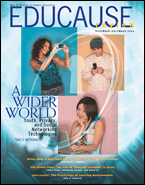 Third post today from reading back issues of Educause Review and this article "The Psychology of Learning Environments" (Ken Graetz, EDUCAUSE Review, vol. 41, no. 6 (November/December 2006): 60–75) is another good read. From his vantage point at Winona State (a Tablet PC school) he discusses the bug-a-boo of students having laptops and doing other things while lectures take place. But his point is rather than this being a major distraction, the curriculum is moving from lecture delivery to collaboration. Bill Becker and Mike Watts have long assailed the chalk and talk delivery and Graetz points out the the presence of computers in the hands of students leads one to collaboration and discussion and in turn this does or should lead to changes in classroom design. At the ASSA meetings in January 2007, Marcelo Cericli Arias (Stanford) spoke compellingly about smart classroom design and how the learning space assisted students in economics to fo "From Zero to Agent-Based Modeling in Ten Weeks," a task unheard of in a non-collaborative environment.
In my posts on 1:1 Computing in Econometrics I discovered that by using DyKnow Vision and Monitor, the projector went off the second day and was rarely used there after since the delivery was to everyone's screen. (Just like my favorite phrase in "24" when Jack or someone says just send it to my screen.) My guess, before reviewing the data is the successful problem based learning experience is in part due to the synergies created by the use of the Tablet PC and DyKnow Vision.
The classrooms need to accomodate collaboration and Gratez goes through the requirements including wall and furniture arrangement as well as class size. He discusses the use of DyKnow, clickers, Synchroneyes, virtual campuses such as Second Life and more.
I found the list of usability criteria he quotes quite interesting and aplicable to a variety of learning spaces and devices. Indeed this also applies to my Tablet PC experiment as well.
- "Learnability refers to the speed and ease with which a novice user can achieve proficiency with the system.
- Efficiency refers to the degree to which the system supports the performance of an experienced user in the shortest amount of time and with the fewest steps.
- Memorability refers to the degree to which a user, particularly an intermittent or casual user, can remember how to accomplish a task using the system, the steps of which were learned previously.
- Errors refer to the number of mistakes and missteps made by users.
- Satisfaction refers to the users' overall emotional experience when using the system. (this list is from Jakob Neilson, Usability Engineering (San Francisco: Morgan Kaufman, 1993)."
"Careful, objective usability analyses of common digital environments should be conducted and problems should be addressed using similar decision-making processes and with the same sense of urgency that campuses apply when addressing poor conditions in brick-and-mortar classrooms."
Monday, March 19, 2007
Online Textbooks

I do not often blog on what randomly shows up in my email, but this is a link from Gateway's 1:1 service that is called VitalSource Bookshelf. I downloaded the free app and searched for economics texts and was disappointed that their aren't more university level texts available. Consider the Tablet PC student with all their notes on and inside the Tablet PC and they still have to carry their books. I use Parkin Economics in my online classes and Addison Wesley allows a link via my econ lab to the full version, but the student has to be online and have a lot of patience to use it. VitalSource offers to put the full copy (under digital rights management) on the student's tablet. How cool is that? Anyone know of other companies offering this? VitalSource boasts of sales partners including Gateway, Lenova and Apple and an impressive list of publisher clients.
Online Economics Textbooks
It is worth noting the list of Online Economics Textbooks and Classic Works at Oswego, some of which can be downloaded into the Tablet PC. Other links, repec, econlib, businessbookmall, EconPapers, and another link at RFE.
Wednesday, February 21, 2007
Learning and Learning Style Preferences
The December 2006 issue of CHEER has an article by Naser-Nick Manochehr, The Influence of Learning Styles on Learners in E-Learning Environments... who shows that students who have learning styles that learn best through lecture, papers, analogies, labortories, field work and observations did better in web based learning. Those who like to learn through simulations, case study, brainstorming and logs did better in instructor based learning.
I have wondered about this ever since learning about learning style preferences in a seminar with Neil Fleming about his VARK quiz to reveal learning style preferences of Visual, Aural, Read/Write and Kinestetic. I have used VARK as a pre-assessment in my online courses to help the students at a distance learn techniques of learning that might help them.
Someday maybe I will correlate all those VARK scores with student performance, maybe someone else will and will comment here.
I have wondered about this ever since learning about learning style preferences in a seminar with Neil Fleming about his VARK quiz to reveal learning style preferences of Visual, Aural, Read/Write and Kinestetic. I have used VARK as a pre-assessment in my online courses to help the students at a distance learn techniques of learning that might help them.
Someday maybe I will correlate all those VARK scores with student performance, maybe someone else will and will comment here.
Tuesday, January 23, 2007
"Best Educational" Software Finalists
 In a news update from Campus Technology today the finalists for the Higher Education 'Codie' awards from the Software and Information industry Association was announced. I wonder if it is accidental that the announcement comes on the same day the finalists for the Oscars are announced, but I digress. In the best education solution overall I see McGraw Higher Education Online Learning and Tutor.com. In the category of best post-secondary CMS is Angel Learning and in the best post secondary instruction solution is Turnitin.com. I looked hard to see if any of the Tablet PC unique software is listed and noticed none. We who have immersed in the Tablet PC world would have a completely different list: DyKnow.com, Classroom Presenter, One Note, Go Binder, MS Journal, (perhaps digital ink in Outlook and MSN Messenger), Adobe Acrobat, and Adobe Connect make up my list. What is yours? What software do you use that derives its value primarily from the platform of the Tablet PC? Comment or email me and let me know.
Wednesday, December 29, 2004
Is there a radical change coming in academia thanks to instructional technology?
This topic has long been a passion of mine and hence this blog is just one outlet for various ideas. In San Diego at the AEA meetings I presented "Six Uses of Technology to Improve Teaching and Learning," (pdf file) January 2004. The fundamental conclusion is that technology should only be used if it meets two conditions: (1) "professor time should be reduced of the repetitive and mundane chores that a computer can do so well or professor time should be used more efficiently" and (2) "student learning should not be harmed and if possible significantly advanced. The six uses are (I) electronic grading, (ii) interactive presentations, (iii) electronic CATS (classroom assessment techniques), (iv) mastery learning testing, (v) electronic portfolios, and (vi) active engagement activities.
Another paper in this mold is by Kim Sosin and Bill Goffe "Teaching with Technology: May You Live in Interesting Times," (pdf file) July 2004. {this paper is no longer there --- Please find it in the Journal of Economic Education. William Goffe and Kim Sosin, "Teaching with Technology: May you Live in Interesting Times" invited paper, Journal of Economic Education, 36(3), Summer, 2005, 278-291.} In my first read through of that paper I am reminded that in my paper, I take the communication enhancement function of computers and the internet for granted and thank them for that reminder. I am also reminded that I marveled when I first discovered that I could prepare overheads on a laser printer in the early 90s. These two papers are an expression of how far we have come. and both point to a future of even more possibilities. Still my two requirements should always be the yardstick by which these technologies should be measured.
I have dabbled in online office hours ("Virtual Office Hours: Tutoring Distance Students in Mathematics, Statistics and Economics" presentation to the Ohio Commons for Digital Education 2004 Conference. March 8-9, 2004), synchronous video distance learning ("The U of Akron Distance Lerning Systems", 1997), asynchronous distance learning, ("Do On-Line Students in a Mastery Based Principles Course Analyze, Synthesize and Evaluate Better Than Face-To-Face Students? pdf file, Presentation to NAEE/CSEE sessions, ASSA meetings, San Diego, January 5, 2004 ), tests of learning styles, (VARK web site), games (Aplia web site), digital ink technology ("Digital Pen Technology in Lecture Presentations," Good Practice Showcase, The Economics Centre of the Learning and Teaching Support Network (LTSN), Universtiy of Bristol, UK, January 2004.), electronic white boards ("SMART Sympoduim: Interactive Lectern Integration Module - Various uses of the Sympodium in teaching," Educause, Atlanta, October 2002 ) and Tablet PCs (see elsewhere in this blog), all mentioned in the concluding section of Sosin and Goffe, but their last sentence is a challenge to all of us, is there a "radical change further down the road that may fundamentally change academia (Sosin and Goffe, p. 22)"?
Lets hear your comments on this question. How will it happen, what is the future? How can instructional technology help us in our mission of enhancing economic literacy? -- Steve
Another paper in this mold is by Kim Sosin and Bill Goffe "Teaching with Technology: May You Live in Interesting Times," (pdf file) July 2004. {this paper is no longer there --- Please find it in the Journal of Economic Education. William Goffe and Kim Sosin, "Teaching with Technology: May you Live in Interesting Times" invited paper, Journal of Economic Education, 36(3), Summer, 2005, 278-291.} In my first read through of that paper I am reminded that in my paper, I take the communication enhancement function of computers and the internet for granted and thank them for that reminder. I am also reminded that I marveled when I first discovered that I could prepare overheads on a laser printer in the early 90s. These two papers are an expression of how far we have come. and both point to a future of even more possibilities. Still my two requirements should always be the yardstick by which these technologies should be measured.
I have dabbled in online office hours ("Virtual Office Hours: Tutoring Distance Students in Mathematics, Statistics and Economics" presentation to the Ohio Commons for Digital Education 2004 Conference. March 8-9, 2004), synchronous video distance learning ("The U of Akron Distance Lerning Systems", 1997), asynchronous distance learning, ("Do On-Line Students in a Mastery Based Principles Course Analyze, Synthesize and Evaluate Better Than Face-To-Face Students? pdf file, Presentation to NAEE/CSEE sessions, ASSA meetings, San Diego, January 5, 2004 ), tests of learning styles, (VARK web site), games (Aplia web site), digital ink technology ("Digital Pen Technology in Lecture Presentations," Good Practice Showcase, The Economics Centre of the Learning and Teaching Support Network (LTSN), Universtiy of Bristol, UK, January 2004.), electronic white boards ("SMART Sympoduim: Interactive Lectern Integration Module - Various uses of the Sympodium in teaching," Educause, Atlanta, October 2002 ) and Tablet PCs (see elsewhere in this blog), all mentioned in the concluding section of Sosin and Goffe, but their last sentence is a challenge to all of us, is there a "radical change further down the road that may fundamentally change academia (Sosin and Goffe, p. 22)"?
Lets hear your comments on this question. How will it happen, what is the future? How can instructional technology help us in our mission of enhancing economic literacy? -- Steve
Subscribe to:
Posts (Atom)